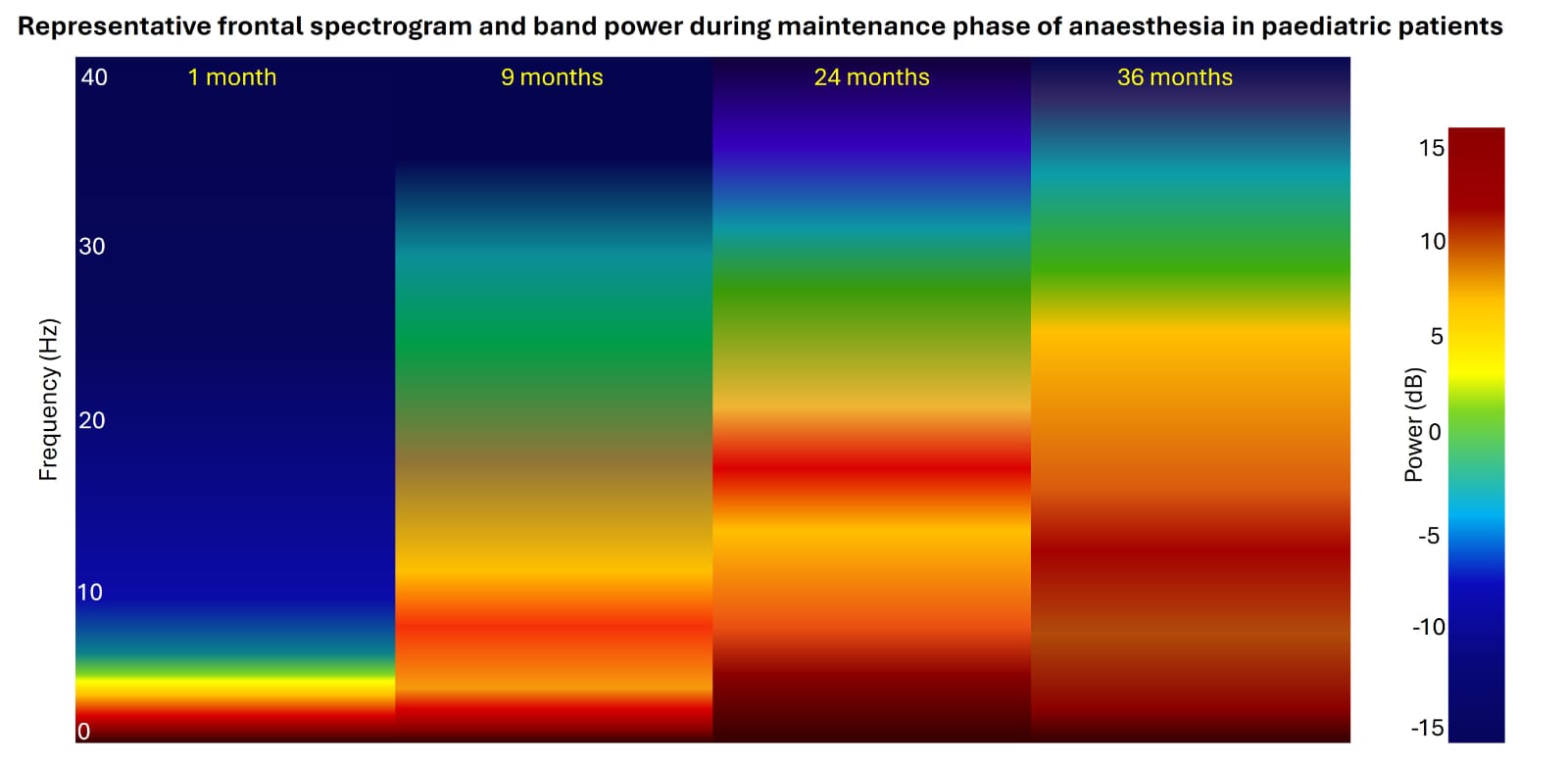
Which age group among paediatric patients show elevated processed EEG values even after maintaining the age adjusted MAC (Sevoflurane) and why ? - Answer & Explanation
- 1-2 years: Delayed cortical recovery is not detected by processed EEG.
- 1-2 years: Subcortical inhibition is not detected by processed EEG. ✓ Correct Answer
- 5-6 years: The lack of global coherence is underestimated by processed EEG
- 5-6 years: Alpha dominance is overestimated by processed EEG.
Explanation:
Maturation pattern in Paediatric EEG in awake patients
Slow–delta (δ) (0.1–4 Hz) from birth and peaks by 0-4 years
Theta (θ)(4–8 Hz) oscillations emerge by ∼4 months and peaks by 3-7 years
Alpha (α)(8–12 Hz) oscillations emerge by ∼4 months and peak 20 – 30 years
Beta (β) (13-30Hz) oscillations emerge by ∼ 4-6 months. Low β (12-20 Hz) peaks by 36 months & High β (20-30Hz) peaks by 7.5 months followed by a gradual decline
Gamma(γ) (30-80 Hz) oscillations emerge by ∼ 8 months and peak 14-16 years followed by gradual decline
Delayed cortical recovery signifies increased depth of anaesthesia with frontal-parietal disconnection and characterised by the following
• Persistence of low-frequency (Slow-Delta and Theta) oscillations
• Absence of alpha oscillations which marks the recovery of consciousness
• Burst suppression where there are periods of brain activity followed by electrical silence
• Frontal-Parietal Disconnection: Anaesthetics reduce frontal-to-parietal connectivity. In delayed emergence, this functional network connectivity remains suppressed
• These patterns are detected by processed EEG quite accurately after 1 year of age hence option A is incorrect.
Coherence: Is a measure of synchrony in EEG across brain regions. Though not specific to anaesthesia, this is a good adjunct measure to depth of anaesthesia, with greater depth displaying better synchronisation across brain regions.
Active thinking involving memory tasks, creative tasks, mental arithmetic etc., typically reduces the coherence of alpha waves in task-relevant brain areas.
In healthy, awake adults with eyes closed, high alpha coherence is typically observed and represents functional coupling, particularly over posterior (occipital) regions. Under general anaesthesia, young adults show prominent, highly coherent frontal alpha waves.
Under anaesthesia slow and delta coherent oscillations are present in subjects from birth until around 8 months of age following which they become incoherent. Alpha coherence emerges around 10 months of age, reaches a peak at 20 months of age and persists into adulthood.
As alpha coherence is established and adequately measured by processed EEG in both the age groups, option C is incorrect.
Adultlike patterns of EEG activity including anteriorisation of alpha oscillations and increase in alpha power are detectable from late infancy onwards. They are both estimated quite accurately and correlate well with depth of anaesthesia. Hence option D is incorrect.
Children below 2 years of age displayed elevated processed EEG values as compared to their older peers with similar MAC (Sevoflurane) in multiple studies. This difference between MAC guided sevoflurane concentration which clinically provides adequate anaesthesia and increased sevoflurane requirements when guided by processed EEG may be due to subcortical (brainstem and spinal cord) inhibition which is not measured by processed EEG in anaesthetised children below 2 years of age. Hence B is the correct answer.