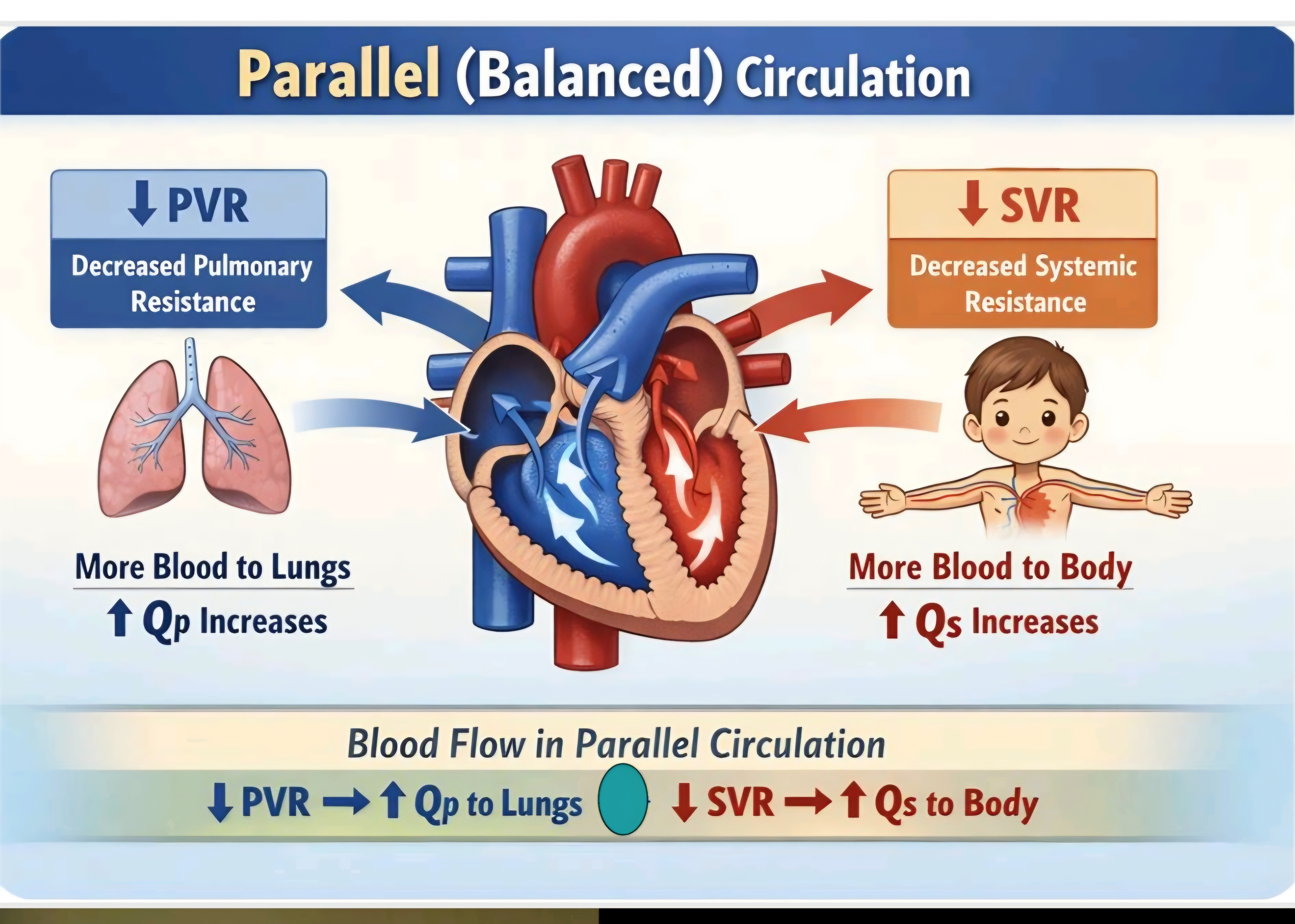
In a child with parallel ( balanced ) circulation , the Qp: Qs ratio is determined primarily by - Answer & Explanation
- Cardiac Contractility
- HR variability
- After load
- Difference between SVR and PVR. ✓ Correct Answer
Explanation:
PARALLEL (BALANCED) CIRCULATION
• Seen in single-ventricle physiology Hypoplastic left heart syndrome, tricuspid atresia, pulmonary atresia with intact septum, Other univentricular hearts pre- or post-initial palliation like Norwood/Sano/BT shunt)
• The pulmonary (Qp) and systemic (Qs) circulations are supplied in parallel from a single (common) ventricle.
The single ventricle ejects its total cardiac output (Qp + Qs) into both circuits simultaneously. The Qp:Qs ratio — is governed primarily by the relative resistances of the two vascular beds:
PVR and SVR
Blood flows preferentially to the lower-resistance pathway (following basic Ohm's law: Flow ≈ Driving pressure / Resistance).
In these patients, anaesthetic management often focuses on carefully manipulating SVR and PVR to maintain balanced circulation and adequate systemic oxygen delivery.
Factors increasing PVR:
Pain
Acidosis
Hypothermia
Sympathetic stimulation
Hypercarbia
Factors decreasing SVR
Anesthetic drugs
Ionodilators like milrinone
Hypovolemia
These factors influence total cardiac output (Qp + Qs) or ventricular performance but do not primarily determine the relative split between Qp and Qs in an unrestricted parallel setup.
Why not the other options?
A. Contractility → Determines the ventricle's intrinsic pumping strength and affects total output (Qp + Qs). Poor contractility reduces overall flow but does not dictate how blood partitions between pulmonary and systemic beds (which depends on relative resistances). •
B. HR variability → Neonates/infants are heart-rate dependent for cardiac output (limited stroke volume reserve). Changes in HR (or variability) impact total output but not the Qp vs. Qs distribution ratio. • C. Afterload → Afterload is the resistance/opposition to ventricular ejection. In singleventricle physiology, systemic afterload ≈ SVR and pulmonary afterload ≈ PVR (plus minor contributions from vessel geometry/compliance). Afterload affects total output and ventricular wall stress, but the difference/ratio between SVR and PVR (i.e., relative afterloads of the two circuits) is what drives the Qp:Qs partitioning. "Afterload" alone is too nonspecific here.